Why ChatGPT Ads Don’t Pay for Most Apps (And How To Fix It)
The short answer
ChatGPT ads for apps: are they worth it, and what does a trial cost?
For most apps, not yet. ChatGPT ads have no install objective, and nobody has published an app's cost per install, trial or subscriber. At $4 a click and the typical AI app's 8.5% trial start rate, one trial costs about $47 even if every tap installs, against about $30 per paying user in year one. Start with the free route: your store listing and a clear one-sentence description.
Key facts
- 3 objectivesViews, clicks and conversions. There's no install objective and no app store field.OpenAI Help, Create campaigns for ChatGPT ads
- 7 in 1,000US ChatGPT answers carrying an ad that got a click, in a panel analysis to mid September.Search Engine Journal on Graphite and Similarweb panel data, click rates by market, 29 September 2026
- $47 a trialBest case at $4 a click and an 8.5% trial start rate, if every tap installs. Appelune calculation.OpenAI Help, Ads in ChatGPT: the basics ($3 to $5 suggested bid)
- 47.5%Share of the sources ChatGPT cited for app questions that were app store listings.AppTweak, sources AI search cites for apps, 30 September 2026
Chapters
- 0:00Should your app advertise inside ChatGPT?
- 0:46What can an app buy in ChatGPT?
- 2:20Do people click ChatGPT ads?
- 3:19Has anyone made money from ChatGPT ads?
- 4:31Can you trust ChatGPT ad numbers?
- 5:42What would one trial cost?
- 7:20Should your app buy ChatGPT ads?
- 9:35How do apps get recommended by ChatGPT?
- 10:48How to test ChatGPT ads for an app
Transcript
Edited for readingTeal is a fictional AI photo editor and its numbers are illustrative; chat screens are illustrative, not ChatGPT's interface. Every other number comes from a real source, listed under Sources.
Should your app advertise inside ChatGPT?Watch from 0:00
Ads inside ChatGPT are now live in over 60 countries. OpenAI says 1.2 billion people use ChatGPT every week. Not all of them see ads. So should your app be buying them?
Here's the catch. You can't buy an install. There's no install button, and nobody has published what an app install costs.
So we did the maths ourselves, with the numbers that do exist. By the end, you'll have eight questions that tell you whether your app should spend a dollar here. Plus a free way into ChatGPT's answers, the one most apps should start with.
Everything here is as of early October, from OpenAI's own pages, named advertiser tests and published studies. Our test app, Teal, is an AI photo editor we made up. The numbers aren't.
What can an app buy in ChatGPT?Watch from 0:46
Start with who sees these ads. Only people on ChatGPT's free plans: that's Free, and a cheap paid plan called Go. Anyone paying for Plus, Pro or a business plan never sees one. Neither does anyone under eighteen. And the ads never appear next to health, mental health or politics.
The ad itself is a small card under the answer. A title, one line of text, an image and a link.
Now the part that matters for an app. When you set up a campaign, you choose one of three objectives. Views, where you pay for impressions. Clicks, where you pay per click. And conversions, where the system bids for an action you pick.
There's no install objective. No install button. No app store field.
The ad points at a web address. For an app, that's usually a tracking link that sends people on to the store.
You can at least choose where it shows. One placement is people inside the ChatGPT app on iPhone. A tap there can go straight to your App Store page.
Since May, a self-serve beta has been opening to businesses in eligible countries. The minimum is $25 a day.
One rule decides whether you can buy at all. The paying business must be based in a country on Ads Manager's list. The UAE is on it. Pakistan isn't. So check that list before you plan anything.
Our take: this was built for websites first. An app can take part, but it plays by a web ad's rules.
But being allowed to buy is the easy part. The question is whether anyone taps.
Do people click ChatGPT ads?Watch from 2:20
So how often do people tap these cards? Out of a thousand US answers that carried an ad, how many got a click?
A panel analysis by Graphite, on Similarweb data to mid September, puts it at about seven. Seven in a thousand. Brazil was the high point, at about nineteen in a thousand.
Now compare it with search. One agency ran the same business clients on both. About one in a hundred clicked on ChatGPT. On Google Search, about five in a hundred.
Those two studies count clicks differently. But they point the same way. People are reading an answer, and most of them don't want to leave it.
And each tap costs real money. OpenAI suggests starting bids of $3 to $5 a click. In the small tests that published numbers, most paid about $3 to $6 a click.
Our take: a low tap rate isn't fatal on its own. A tap from someone who just asked for your kind of app could be worth a lot. So the real question is what those taps turned into.
Has anyone made money from ChatGPT ads?Watch from 3:19
Here's what advertisers have actually reported so far. Business software went first. An industrial marketing agency spent about $1,500 and got zero conversions. An SEO tool saw almost no sign-ups. A business marketing agency got no qualified leads, against two on Google.
None of these were apps. But they show what a tap turned into.
Then there's the best public result. An ecommerce agency, Common Thread Collective, ran ads for a store with high-value orders. By its own estimate, it got back 3.3 to 6.8 times what it spent. The range depends on how sales are attributed. That's one store with big orders, measured its own way. But it's a real result.
Now look for the app result. As of early October, nobody has published one. No cost per install, per trial or per subscriber. Not from an advertiser, an agency or a measurement company.
Grubhub runs ChatGPT ads measured in AppsFlyer. It hasn't published a cost per install or per subscriber.
Our take: while app brands like Grubhub test quietly, your only benchmark is the one you build yourself. And building it is harder than it sounds, because of how these installs get counted.
Can you trust ChatGPT ad numbers?Watch from 4:31
Why is an app install so hard to measure here? On iPhone, Meta, Google and TikTok also get Apple's privacy-safe install reports, called SKAdNetwork. OpenAI's docs list click-based attribution only.
So an install only counts if your measurement tool can match the tap to the install. On iPhone, expect it to miss some.
Seven measurement companies are connected, including AppsFlyer, Adjust, Branch and Singular. All of them count from clicks, and the numbers arrive a day or two late.
And the platform's own reporting doesn't always match. A UK agency told Digiday the platform reported about a hundred clicks. Its own tracking saw twenty. The same agency is keeping clients' tests at £10,000 to £20,000 until it can verify results.
So read ChatGPT's dashboard as a rough guide. Your measurement tool and your revenue data decide what's true.
Our take: prove your tracking end to end before the first dollar. Otherwise you can't tell a win from a mistake.
There's also a free way into ChatGPT's answers, and almost half of what it cites for apps is a page you already have. First, the maths. What would it cost Teal to get one person to start a free trial?
What would one trial cost?Watch from 5:42
Teal is our AI photo editor. Say it starts trials at the rate of the typical AI app. RevenueCat's 2026 report puts that at 8.5% of downloads.
Could taps from a chat start trials more often than average? Maybe. Nobody has measured it, so we use the typical rate.
Now the price of a tap. $4, the middle of OpenAI's suggested range, and about what the small tests paid.
Start with the best case possible: every single tap installs Teal. Then one trial costs about $47.
Real taps don't all install. The person has to leave the chat, load the store and tap Get. Each extra step loses people. They came to get an answer. Shopping wasn't the plan.
Say one in four makes it. That's our assumption, because no measured number exists. At one in four, a trial costs about $190.
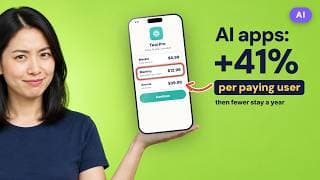
Now the number that decides it. In RevenueCat's data, the typical AI app makes about $30 per paying user in its first year. We broke that down in Why AI Apps Earn More but Keep Less (And How To Fix It).
So at $4 a tap, a trial costs $47 if every tap installs. On our assumption, it's nearer $200. Either way, it buys a customer worth about $30 in year one. And not every trial pays.
Even if every trial became a paying user, Teal would lose money on each one in its first year.
Our take: for a typical AI app, ChatGPT ads don't fail on clicks. They fail on arithmetic. So which apps do pass? That's the check.
Should your app buy ChatGPT ads?Watch from 7:20
Here are the eight questions. Your app needs a yes on every one before you spend.
One: is your category allowed? Dating apps and cash-prize games are banned outright. Finance and health apps are generally limited to the US.
Two: are your users in a market where the ads run? Three: is your company in a listed country?
Four: do people ask ChatGPT for what your app does? How do I remove a background from a photo. What's the best app to learn Spanish. If nobody describes your need in words, there's nothing for the ad to match.
Five: can your economics pay for a trial? Write down what you can afford per trial and per paying user. As a rough line, if a paying user isn't worth well over $47 in year one, stop here.
Six: is your tracking proven? A supported measurement tool, with trials and purchases already flowing into it.
Seven: does another paid channel already work? If Apple Ads or Meta can't bring paying users near your target, fix that first. Your store page, onboarding or paywall.
Eight: can you fund a real test without starving the channel that works? At one in four taps installing, thirty trials would cost Teal about $5,600. That's one country, on one platform.
Now run Teal through it. Category: allowed. But OpenAI can turn away rivals to its own business, so an AI app should expect questions. Market, account and chat intent: yes. People do ask ChatGPT how to fix their photos.
Economics: no. About $30 per payer can't cover a trial that costs $47 even if every tap installs. Tracking: not proven yet. Another paid channel: not yet. Budget: not without hurting everything else.
Teal's verdict is organic first. It looks again when its numbers change.
And that's the honest verdict for most apps today. The ones that pass sell something valuable from the first purchase. They're in a live market, and they already make money on another channel.
Our take: ChatGPT ads are a test for apps that already win somewhere else. Not a place to find your first customers. But every app, Teal included, can still show up in ChatGPT's answers without paying.
How do apps get recommended by ChatGPT?Watch from 9:35
ChatGPT already recommends apps, with no ad in sight. So where does it get them?
AppTweak studied more than 125,000 ChatGPT answers to app questions in the US. Almost half of the sources it cited were app store listings. The App Store alone was more than a third.
And apps in the top four spots usually came with a cited source. By the eighth spot, mostly not.
So the work is plain. Write one clear sentence that says what your app does and who it's for. Use it word for word in your subtitle, the top of your description, your website and every profile.
Give the app its own web page with that sentence, its features and its prices. And check your site doesn't block OpenAI's search crawler. Blocked sites don't show in ChatGPT search answers.
Then earn mentions elsewhere. Best-of lists, comparison pages, genuinely helpful answers on Reddit. Keep it fresh, with dated updates and release notes.
And measure it. Some attribution tools, AppsFlyer for one, now track installs that come from AI answers.
Our take: the store listing you already have is the cheapest ChatGPT placement you'll ever get. And if your app does pass all eight questions, there's one test worth running.
How to test ChatGPT ads for an appWatch from 10:48
Choose the conversions objective, aimed at trial starts. One agency, Jellyfish, said switching to conversion bidding was a turning point.
Point the ad at your measurement tool's link, carrying OpenAI's click ID, with a seven-day lookback.
Run iPhone and Android as separate campaigns, so each store reads on its own.
Fund thirty trials per campaign and run it for at least four weeks. Then judge cost per paying user against what a payer is worth to you in year one.
Over one and a half times your limit after that? Stop. Under it? Hold back one region with no ads before you scale, to check the installs are really new.
Never call it a win on taps, cheap bids or the platform's own conversions.
Can AI make your app ads instead? We tested it in AI App Ads: We Tested 20. 0 Were Usable.
Sources
- OpenAI, Testing ads in ChatGPT
- OpenAI, ChatGPT ads in over 60 countries (23 September 2026)
- OpenAI Help, Ads in ChatGPT
- OpenAI Help, Create campaigns
- OpenAI Help, Ads in ChatGPT: the basics ($3 to $5 bid)
- OpenAI, self-serve beta (5 May 2026)
- Adweek, $200,000 beta minimum (31 January 2026)
- OpenAI, DevDay recap (29 September 2026)
- OpenAI, Ad policies
- Search Engine Journal on Graphite and Similarweb panel data, click rates by market (29 September 2026)
- Workshop Digital, B2B test (26 August 2026)
- Search Engine Journal, 6 months into ChatGPT ads (8 September 2026)
- Digiday, measurement gaps (1 October 2026)
- OpenAI Help, MMP integrations
- AppsFlyer, ChatGPT ads measurement (5 August 2026)
- AppsFlyer, AI answer attribution (16 September 2026)
- RevenueCat, State of Subscription Apps 2026 (AI app medians: 8.5% trial start, $30.16 per payer in year one)
- AppTweak, sources AI search cites for apps (30 September 2026)
- OpenAI, crawlers (OAI-SearchBot)
- Search Engine Journal on Ipsos (1,085 US adults)
Caveat: No app cost per install, trial or subscriber from ChatGPT ads had been published as of 3 October 2026, so the $47 and $190 per trial are our own calculations ($4 a click divided by 8.5%, then with 1 in 4 clicks installing, an assumption, not a measured rate). RevenueCat's figures are medians across different apps. AppTweak's App Store and Google Play shares sum to 47.2% against its 47.5% headline (rounding in the source). ChatGPT ads change almost every month.