How Much Money Do Apps Actually Make?
The short answer
How much money do apps make? What the typical app earns in 2026
One year after launch, the typical subscription app that's already earning makes about $72 a month, and the top 10% make $2,574 or more. Only 17 of 100 new subscription apps reach $1,000 a month within two years. The median app earns 34 cents per download in its first 60 days. Top earners differ most on when they ask for money, what they charge and which plans people keep.
Key facts
- $72 a monthWhat the typical subscription app makes one year after launch, among apps already earning.RevenueCat, State of Subscription Apps 2026
- 17 of 100New subscription apps that reach $1,000 a month within their first two years.RevenueCat, State of Subscription Apps 2026
- $0.34Median revenue per download, counted within 60 days of each download.RevenueCat, State of Subscription Apps 2026
- $94.50 of $100The share of subscription revenue taken by the top 10% of apps in Adapty's data, 2025.Adapty, State of In-App Subscriptions 2026, 5 March 2026
Chapters
- 0:00How much money do apps make?
- 0:49Where does $167 billion in app spending go?
- 1:51What does a typical subscription app make?
- 3:10How many apps reach $1,000 a month?
- 4:24Is it harder to make money with an app now?
- 5:50What is one download actually worth?
- 7:35Where do top earners differ from typical apps?
- 9:29What can't this data tell you?
Transcript
Edited for readingHow much money do apps make?Watch from 0:00
One year after launch, the typical subscription app that's already earning makes about $72 a month. Not a day. A month.
Yet in 2025, people spent $167 billion inside apps and games. So where does all that money go? And what decides which side your app lands on?
By the end, you'll know what one download is really worth. You'll know how many new apps reach $1,000 a month. And you'll see the three numbers where top earners differ most.
The numbers come from three 2026 reports. RevenueCat's covers more than 115,000 subscription apps. Adapty's covers more than 16,000, and Sensor Tower estimates app store spending.
The dashboards in the video are illustrations. Every number on them is published data, and where we did the maths, we say so.
Where does $167 billion in app spending go?Watch from 0:49
Start with the big number. $167 billion. That's Sensor Tower's estimate of spending in the App Store and Google Play in 2025. Apps, games and subscriptions. And for the first time, non-game apps took more of it than games.
That sounds like plenty to go around. But the money isn't shared evenly.
Take every $100 of subscription revenue in Adapty's data. How much of it goes to the top 10% of apps? Make a guess.
$94.50.
The other 90 apps in every 100 share what's left. $5.50, between all of them. And the top's share has grown over the last two years. The money is pooling, not spreading.
One more thing about that big number. It's what people paid, not what developers keep. The store takes its cut first, and we'll see how much that is later.
Our take: the app economy isn't small. It's lopsided. So the useful question isn't how much apps make in total. It's how much a typical subscription app makes.
What does a typical subscription app make?Watch from 1:51
RevenueCat measured it one year after each app launched. Not the total for the year. Just how much the app was making per month by then.
Now line the apps up, from lowest to highest. The bottom 10% make $5 a month or less. The middle app, the median, makes about $72. That's about $2.40 a day. Roughly the price of a coffee.
To reach the top quarter, an app needs a few hundred dollars a month. And the top 10% start at around $2,500. That's 36 times the median.
Remember who's in this data, though. These are apps that already earn subscription revenue. Apps making nothing aren't counted, so the real typical app likely makes less.
Category changes the picture. Photo and video apps have the highest median, about $124 a month.
Games are the strangest. A typical subscription game makes about $56 a month. The top 10% make over $4,500.
Our take: in subscription games, the typical result is poor and the best result is huge. That's closer to a lottery ticket than a business plan.
But a median only tells you where apps sit. It doesn't tell you how many ever get anywhere. So how many cross $1,000 a month?
How many apps reach $1,000 a month?Watch from 3:10
Our rough line: at $1,000 a month, an app starts to look like a side business. Not a hobby.
RevenueCat followed new subscription apps through their first two years. Out of every 100, how many reached $1,000 a month? Guess.
Seventeen.
Eighty-three out of 100 didn't get there in their first two years. And $10,000 a month? Fewer than five in 100.
Adapty's data points the same way. Look at new apps that made at least a dollar. Fifty-eight in 100 made less than $1,000 in total, across their whole first year.
Now here's the part that surprised us. Among the apps that got to $1,000 a month in their first two years, it didn't take long. The median took 58 days. $10,000 a month took 109. About two months, and under four.
It depends on what you build. Games that got there took about a month. Business apps took nearly four.
Hold on to that speed. It matters for what the top earners do differently, and we'll come back to it.
Our take: when an app is going to earn, we think it usually shows early. That makes the first few months the time to fix things, not the time to wait.
But there are far more apps launching now than there used to be.
Is it harder to make money with an app now?Watch from 4:24
In January 2022, about 2,000 new subscription apps launched every month. By January 2026, it was almost 15,000. A month.
RevenueCat calls apps launched since 2025 the vibe coding era.
Adapty saw a squeeze in a single year. There were nearly a third more subscription apps. And the median new app earned about a fifth less per month than the year before.
So who earns the money now? Split subscription revenue in January 2026 by the year each app launched. Apps launched before 2020 earned 69 cents of every dollar. Apps launched in 2025 or later earned 3 cents.
Some of that is just time. A new app hasn't had years to build up paying users. But it shows who you're up against: apps with years of reviews, rankings and subscribers.
There's a popular idea that the stores are now too crowded to win. The data says something more interesting.
Look at how revenue changed in one year for apps that were already live. The median app grew about 5%. The top 10% more than quadrupled. And the bottom 10% lost more than half.
So the typical app roughly held its ground. A few grew fast, and a few shrank fast.
Our take: a crowded store doesn't stop good apps growing. But standing still isn't safe.
So what separates the apps that grow? Start with the smallest unit in the business. One download.
What is one download actually worth?Watch from 5:50
Here's a typical app's dashboard. Downloads, payers, revenue. The question is what each download turns into.
In RevenueCat's data, the median app earns 34 cents per download, within 60 days of each download. Thirty-four cents.
The bottom 10% earn almost nothing. The top 10% earn more than $2.
Put that in real terms. 10,000 downloads at the median is about $3,400 within 60 days. And most apps get far fewer downloads than that.
Why so little? Because most downloads don't pay. At the median app, two out of 100 pay within five weeks. In the top 10% of apps, it's nine or more.
At the median app, a paying user brings in about $23 in their first year.
Where your users are matters too. In the first 60 days, a download in North America earns about 55 cents at the median. In India and Southeast Asia, about 11.
So does the store. An App Store download earns about 42 cents in that time. A Google Play download, about 16.
But here's the twist. Over a year, a paying user is worth almost the same on both stores. So the gap is mostly how many people pay, not what they pay.
And on the App Store, the store's cut comes out of every sale. On a $9.99 subscription, you keep about $7 in a subscriber's first year, before taxes. After that first year, you keep about $8.50. Small developers in Apple's Small Business Program keep that from the start.
Our take: if you track one number from this video, make it revenue per download. It rolls conversion, price and early renewals into one figure you can compare.
So where do top earners pull ahead on each download?
Where do top earners differ from typical apps?Watch from 7:35
Remember how quickly the successful apps reached $1,000 a month? Here's why that matters. In this data, apps that earn tend to start early. And three numbers differ most between apps.
Number one: when you ask. A hard paywall means you pay, or start a trial, before you can use the app. At the median, apps with one turn about 11 of every 100 downloads into payers within five weeks. Freemium apps turn about two.
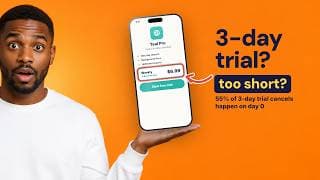
And a year later, both keep their annual subscribers at almost exactly the same rate. The hard paywall apps don't show weaker loyalty. We compared the two models in our video Why Your 3-Day Free Trial Isn’t Working (And How To Fix It).
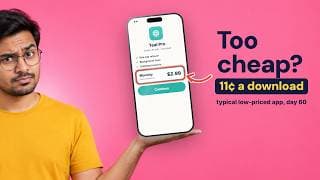
Number two: what you charge. In high-priced apps, a paying user brings in about $62 in the first year. In low-priced apps, about $11. That's the whole story of our video Why Your App Pricing Isn’t Working (And How To Fix It).
Number three: how long people stay. After one year, about 27 of every 100 annual subscriptions are still paying. For monthly plans, 8. For weekly, about 1. That counts who's still paying, not total revenue. A weekly plan can still earn a lot before people leave.
AI apps show how these pull against each other. Their paying users are worth more, but fewer of them stay. That's our video Why AI Apps Earn More but Keep Less (And How To Fix It).
These compare different apps, so they show a pattern, not a promise for yours.
So where does the gap between $72 a month and $2,500 come from? These three numbers are where the medians differ most. Apps with a hard paywall convert more downloads. Higher-priced apps earn more per payer. And annual plans keep far more subscribers.
Our take: you can't control how many apps launch this year. You can control these three. The first two show up in your first two months. Retention takes a year to read.
What can't this data tell you?Watch from 9:29
What this data can't tell you. RevenueCat and Adapty only see apps that already earn subscription revenue, so the real picture is likely worse.
They compare different apps, so they show patterns, not what one change will do to yours. And ad revenue isn't counted at all.
Three things to check this week.
One. Work out your revenue per download at day 60, and compare it with 34 cents.
Two. Check when you first ask for money. If people can use the whole app first, test asking sooner.
Three. Find which plan most people buy, and how many of them are still paying a year later.
Sources
- RevenueCat, State of Subscription Apps 2026 (115,000+ apps, $16B+ revenue, 2025 data; only apps with active subscription revenue above a minimum threshold)
- Adapty, State of In-App Subscriptions 2026 (16,000+ apps, $3B+ revenue, 2025, gross, mostly App Store) (5 March 2026)
- Sensor Tower, State of Mobile 2026 press release ($167 billion of in-app purchase spending in 2025, App Store and Google Play, gross estimates, ads excluded) (21 January 2026)
- Apple Developer, Auto-renewable subscriptions (70% in a subscriber's first year, 85% after)
- Apple Developer, App Store Small Business Program (85% for enrolled developers under $1M a year)
Caveat: Both benchmarks leave out apps earning nothing, so the real typical app likely earns less. They compare different apps, not one app changing, and ad revenue isn't counted. Our maths: 83 of 100 (100 minus 17.3), about $2.40 a day ($71.93 / 30), about $3,400 (10,000 downloads x $0.34), $5.50 for the other 90 apps, and $6.99 and $8.49 on a $9.99 subscription, before taxes.