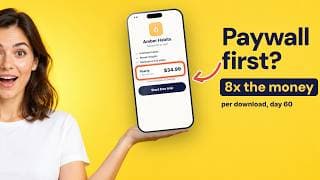
Why Your Paywall Design Is Losing Sales (And How To Fix It)
The short answer
Paywall design: what top apps do after users say no
More than 9 in 10 people who see a paywall don't buy on the first view, so what happens after the no matters. The best apps make the close button honest, show one calm offer after a cancelled purchase, follow up within a day, ask why people said no, and promise a reminder before a trial charges. Discount the moment, never the product.
Key facts
- 17%Share of all revenue that came from one screen shown only to people who had just backed out of buying ($80,590 of $475,550).Superwall, transaction abandon paywalls case study (18 companies, 525,547 users), undefined 2024
- 3.3% vs 6.8%Refund rate for people who saw that offer, against everyone else.Superwall, transaction abandon paywalls case study (18 companies, 525,547 users), undefined 2024
- +23%Trial sign-ups after a paywall showed a trial timeline and promised a reminder. Complaints fell 55%.Growth.Design, trial paywall case study
- 9 in 10Subscriptions that sell at full price, which is why a permanent discount backfires.Adapty, what a high-performing paywall looks like in 2026, March 2026
Chapters
Transcript
Edited for readingGrey and Amber are fictional twin language apps. Every number comes from a real study, listed under Sources.
17% of revenue from one screenWatch from 0:00
17% of all revenue. In a study of 18 app companies, that's how much came from one screen, shown only to people who had just backed out of buying.
Most apps don't have that screen. When someone says no, the app lets them walk away. And almost everyone says no. More than 9 in 10 people who see a paywall don't buy on the first view. In apps with a free version, only about 2 in every 100 downloads become a paying customer in the first 5 weeks.
So what an app does after the no matters more than most teams think. The best apps have a plan for it: five moves, and one trap that looks like a smart idea.
Meet the twinsWatch from 0:40
Grey and Amber are identical language apps. Same lessons, same price, same 10,000 downloads. And the same soft paywall: you can close it and keep learning for free.
Quick note: Grey and Amber don't exist. We built them. But every number here comes from a real study, and every source is listed below.
Here's the only difference. When you close Grey's paywall, the conversation is over. Amber has a plan for every no.
Move 1: The clean exitWatch from 1:07
Move one sounds backwards: make it easy to say no.
Grey's team thinks every second on the paywall is a chance to sell. So the close button is tiny, it's grey on grey, and it only appears after a few seconds. The price sits in small print under the button. It feels clever. But people who feel trapped don't buy, they leave. And the ones who pay by mistake come back for a refund, and a one-star review.
Apple is pushing back, too. Since the middle of January 2026, Apple has been rejecting paywalls with a free trial toggle, a switch that turns the trial on or off. Apple's reason: it can hide the fact that the subscription starts charging when the trial ends.
Amber's close button is there from the first second, and it works on the first tap. The price, the trial length, and the day you'll be charged are all in plain sight.
Move one: a clean exit. Every other move depends on a no that doesn't feel like a trap.
Move 2: The half-finished purchaseWatch from 2:03
Move two happens in a moment most teams never look at. Someone taps subscribe. The App Store sheet slides up and asks them to confirm. And they cancel.
It happens far more than you'd think. Superwall studied 18 app companies, and found that only about half of the people who start an in-app purchase actually finish it. Across everyone who saw a paywall, about 1 in 5 ended up in exactly that spot. They tapped buy, then backed out.
Grey does nothing. The sheet closes, and the person is back in the free app. Amber shows one more screen, right then, with a lower price.
And it's easier to build than it sounds. When someone cancels that App Store sheet, the store tells the app the person cancelled. Paywall tools like Superwall can show a different screen on exactly that event.
More than half a million users were in that study. The people who saw that one screen brought in $80,590, out of $475,550 in total. 17% of all revenue, from people who had already backed out once.
You'd expect a discount for people who hesitated to cause regret, and refunds. It went the other way. In the group that saw the offer, 3.3% asked for a refund. Everyone else, 6.8%.
One warning. Superwall itself says this can cause trouble with App Review. One developer shared the rejection Apple sent for a one-time offer that appeared after the paywall closed. Apple's words: the app "attempts to manipulate customers into making unwanted in-app purchases". So Amber keeps it calm. No pressure, no last chance. One offer, shown once.
Move two: the moment after a cancelled purchase is the warmest no you'll ever get. Answer it once, and calmly.
Move 3: The first dayWatch from 3:45
Move three is about time. Adapty's 2026 report covers more than 16,000 apps and $3 billion in subscription revenue. 90% of free trials start on day 0, the day of the download. And Adapty says the next part plainly: most users who don't convert during onboarding never come back to the paywall.
Grey accepts that. Close the paywall, and Grey waits for you to come back on your own. Most people never do.
Amber doesn't wait. Anyone who closes the paywall without buying gets one welcome offer, open for 24 hours, and it says so plainly. People who already paid full price never see it. Amber's offer is one line: half price on your first year, for the next 24 hours. The deadline is real, so there's no timer ticking in seconds, just the time it ends.
Adapty says a welcome offer like this, aimed only at people who didn't buy, typically lifts revenue per user by 10 to 15%, without cheapening the app for the people who'd have paid in full anyway.
And when a free user reaches a locked lesson, Amber shows the paywall again, because now they know exactly what they'd be paying for. Never on every app open, and less often each time they say no.
Move three: don't wait for them to come back. Most won't.
Move 4: Ask whyWatch from 5:10
So far, Amber's second offers are the same for everyone. But there's one question that tells an app exactly which offer to show, and almost no app asks it.
The second time someone closes Amber's paywall, Amber asks one question, with one tap to answer: what stopped you? Four answers. It's too expensive. I'm not sure it works for me. I want to try it first. Or, just not now.
Each answer gets its own next step. Too expensive: the yearly plan, shown as a price per month. Not sure it works: one lesson from the paid course, free. Want to try first: the free trial, with the charge date spelled out. Not now: nothing today, just a reminder later, if they've allowed reminders.
Keep it to one screen: four big buttons, and a way to skip. And the answers pay off later. If most people tap "too expensive", that's a pricing problem, not a paywall problem.
This move doesn't come from a big study. It's from our own playbook, so treat it as a test worth running, not a proven number.
Move four: a no is information. Ask for it.
Move 5: The reminderWatch from 6:08
Move five surprised us most. The biggest fear at a free trial paywall isn't the price. When Growth.Design studied the trial paywall of a reading app, the number one fear was forgetting to cancel, and getting charged.
You can see that fear in the numbers. 33% of all cancellations happened right after people started the trial. They signed up, then cancelled straight away, just to be safe.
So the paywall changed. It showed a simple timeline of the trial, from today to the day you're charged, and it promised a reminder before the trial ends. Trial sign-ups went up 23%. Complaints fell 55%. And the share of people who allowed notifications jumped from 6% to 74%.
It's also the kind of screen Apple wants. RevenueCat lists this timeline paywall as a replacement for the free trial toggle Apple now rejects.
Grey keeps the fine print. Amber puts the charge date on the screen, and promises to remind you.
Move five: the reminder is what makes people start.
The trap: the permanent discountWatch from 7:07
Now, the trap. With all these offers, it's tempting to put a discount on everything. 80% off, on every screen, all the time.
Here's the data. 9 in 10 subscriptions sell at full price, according to Adapty's 2026 report. Most teams see low conversion and reach for a discount, and Adapty says that instinct is usually wrong. When the discount is always there, it stops being an offer and becomes the price. And people who would have paid in full learn to close the paywall and wait.
That's why Amber's offers are narrow. One after a cancelled purchase. One in the first day, for people who didn't buy. Each one shown once, only to people who said no.
The rule: discount the moment, not the product.
The scoreboardWatch from 7:51
Grey: one paywall, one chance, and a close button you have to hunt for.
Amber: a clean exit. One calm offer after a cancelled purchase, where one study saw 17% of all revenue. A welcome offer in the first day, typically worth 10 to 15% more revenue per user. One question to learn why. And a reminder promise that lifted trial sign-ups by 23%.
If you only build one of these this month, start with move two. It has the strongest evidence, and it only reaches people who were one tap away from buying.
Same app, same paywall, same 10,000 downloads. Most people will still say no. The difference is what happens next.
How should you price your app?Watch from 8:32
How to price your app, and what the 2026 data says about it, is the subject of Why Your App Pricing Isn’t Working (And How To Fix It).
Sources
- Superwall, transaction abandon paywalls case study (18 companies, 525,547 users) (undefined 2024)
- Airbridge, what to do after a user rejects your paywall (undefined 2026)
- RevenueCat, State of Subscription Apps 2026 (March 2026)
- Adapty, what a high-performing paywall looks like in 2026 (State of In-App Subscriptions 2026, 16,000+ apps) (March 2026)
- RevenueCat, R.I.P. toggle paywall (February 2026)
- Apple Developer Forums, a rejection for a one-time offer shown after the paywall closed
- Growth.Design, trial paywall case study
Caveat: Move 4 (ask why) is our own playbook, not a study. The Superwall revenue figure is not a controlled test: it is revenue from the people who saw the screen.