Apple Search Ads Keywords: Which Ones Actually Pay?
The short answer
How to optimize Apple Search Ads keywords for paying users
Judge each Apple Search Ads keyword on cost per paying user, not cost per download: what the keyword spent divided by the paying users it brought. Apple's AdServices attribution data includes a keyword ID, so your attribution or subscription tool can tie each payer to a keyword. Then, once a week, give every keyword one move: raise the bid, hold, cut the bid, or block wrong search terms as negative keywords.
Key facts
- keywordIdApple's attribution data includes the keyword ID behind an install from your ad, but not the search term the person typed.Apple Developer, AdServices attributionToken(), 12 November 2026
- Search MatchApple's documentation says the keyword ID can be missing when Search Match is on, so keep Search Match in its own ad group.Apple Developer, AdServices attributionToken(), 12 November 2026
- attribution = falseWhat Apple's attribution data returns for installs from ad groups that use age or gender settings.Apple Developer, AdServices attributionToken(), 12 November 2026
- Under 10 impressions a dayA search term below this shows as low volume in Apple's search term charts.Apple Ads Help, Use the Charts dashboard, 12 November 2026
- Exact matchNegative keywords are exact match by default, so a blocked search term needs its common variants added too.Apple Ads Help, Use negative keywords
Chapters
Transcript
Edited for readingCoral is a made-up document scanner app used on this channel, and its numbers are illustrative. Every other fact comes from Apple's pages, listed below.
Apple Search Ads optimization: the short answerWatch from 0:00
Apple Ads shows you what each keyword costs per download. For a subscription app, that's not the number that decides anything.
Judge every keyword on what one paying user cost. Apple's attribution data can tell you the keyword behind a download. So you can.
Then once a week, give every keyword one of four moves. Raise, hold, cut, or block. Here's how, in three steps.
Why does cost per download mislead you?Watch from 0:24
First, why. Two keywords from Coral, the made-up document scanner app we use on this channel. The numbers are illustrative.
Document scanner, and scan receipts. Both cost three dollars a download. Same price. Which one is the better buy?
Document scanner brought two paying users from a hundred downloads. That's a hundred and fifty dollars per payer. Scan receipts brought ten payers from eighty downloads. Twenty-four dollars each.
Same cost per download. Over six times the cost per payer.
The formula is simple. What the keyword spent, divided by the paying users it brought.
Which keyword brought each paying user?Watch from 1:01
Step one. Get the keyword behind every download. When someone installs from your ad, Apple's attribution data includes a keyword ID. Your attribution or subscription tool can save it with that user. So when they pay, you know the keyword.
Two catches. First, the search term they typed isn't in that data. Only your keyword.
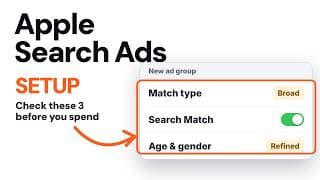
Second, Apple's documentation says Search Match can leave the keyword ID out. So keep Search Match in its own ad group, and judge that ad group as one keyword.
And keep age and gender targeting off. Those ad groups return attribution false.
When is a keyword ready to judge?Watch from 1:37
Step two. Don't judge too early. Set a target cost per payer first. For Coral, a yearly payer is worth about twenty-five dollars in year one. That's the ceiling.
Our rule: no keyword gets cut for having no payers until it has spent three times that target. For Coral, about seventy-six dollars. Before that, one payer more or less swings the number too much to trust.
If payers come in slowly, watch trial starts as the early signal. Make the final call on payers.
One more thing. In Apple's search term charts, a term under ten impressions a day shows as low volume. Our tip: widen the date range before you read them.
Raise, hold, cut or block?Watch from 2:17
Step three. Once a week, one move per keyword.
Raise. Cost per payer is under your target. Apple's advice for keywords under target: raise the bid in small steps. We apply it to cost per payer. Scan receipts. Twenty-four dollars, under the target. Raise it a little.
Hold. Close to target, or not enough spend yet. Receipt scanner for taxes has spent forty dollars. Too early. Hold.
Cut. Taps come in, but payers cost more than your target. Apple says adjust the bid to keep costs down. Document scanner. A hundred and fifty dollars a payer, with three hundred spent. Lower the bid.
Our take: if it's still over target a few weeks after the cut, pause it. And before you cut, remember ads can now show lower in search results. You can't pick the slot.
Block. This one comes from the search terms report, not your keyword list. Coral can't edit PDFs. So when pdf editor shows up as a search term, it goes in as a negative keyword. Negatives are exact match by default, so our rule is to add the common variants too.
It works the other way too. Apple says when a search term performs well, add it as an exact match keyword at a higher bid. Now it has its own keyword ID, and its own payers.
The weekly keyword routineWatch from 3:35
So here's the weekly routine.
One. Save the keyword ID with every user, and keep Search Match in its own ad group.
Two. Judge each keyword on cost per payer, not cost per download.
Three. Wait until it has spent three times your target.
Four. Raise, hold, cut, or block. One move per keyword, once a week.
Sources
- Apple Developer, AdServices attributionToken() (payload fields, keywordId and Search Match, age or gender returns attribution false) (12 November 2026)
- Apple Ads Best practices, Manual Bidding (12 November 2026)
- Apple Ads Help, Tips for solving performance issues (12 November 2026)
- Apple Ads Help, Use the Charts dashboard (low volume under 10 impressions a day) (12 November 2026)
- Apple Ads Help, Use negative keywords
- Apple Ads Help, Reporting options and definitions (12 November 2026)
Caveat: Our rules, not Apple's: judging on cost per payer, the 3x spend threshold, trial starts as the early signal, adding negative variants, and pausing after a cut.