ChatGPT Intelligent UI: Which Apps Lose?
The short answer
Which apps can ChatGPT's Intelligent UI replace?
ChatGPT's Intelligent UI can build a small tool, like a bill splitter or calculator, inside a chat, but OpenAI's help page says its state is not kept across chat threads. Our read: apps people use once are the most exposed. Apps that remember something for the user, remind them or take payments are safer, for now.
Key facts
- 1.2 billionPeople OpenAI says use ChatGPT each week, the audience Intelligent UI reaches.OpenAI, GPT-6 for everyone, 7 October 2026
- Not kept across chatsOpenAI's help page: "State is not retained across chat threads." A new chat starts the tool from zero.OpenAI Help Center, Intelligent UI in ChatGPT
- About 75% lessAnthropic says Claude Haiku 5.5 costs around 75% less per task than Haiku 4.5, at a tenth of the price per token.Anthropic, Introducing Claude Haiku 5.5, 7 October 2026
- Nearly halfShare of bigger paying teams on Vercel's AI gateway that changed their most-used model in one month.Vercel, AI Gateway Production Index: October 2026, 15 October 2026
- 6 million+Installs Google says Play in Gemini drove in its first two months (Google data, 19 May to 31 July 2026).Android Developers Blog, New tools for discovery and engagement, 13 October 2026
Chapters
Transcript
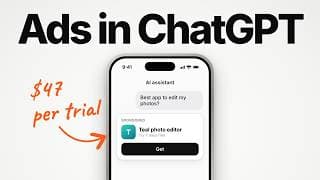
Edited for readingTeal is a fictional AI photo editor and its numbers are illustrative. The chat screens in the video are our own simplified design, not ChatGPT's interface; every other number comes from a real source, listed under Sources.
ChatGPT Intelligent UI: which apps lose?Watch from 0:00
ChatGPT's Intelligent UI can now build a small tool inside a chat. Ask it for a bill splitter, and you get one. Buttons, totals, done. And OpenAI says ChatGPT reaches more than 1.2 billion people a week.
So which apps lose? Our read: apps people use once are the most exposed. Why comes down to one line on OpenAI's own help page.
If you run a small app business, this is what moved in AI, as of 17 October. Four changes, ranked by how much they touch your app. Number one is that chat tool, and we'll sort which apps it really threatens.
What changed in ChatGPT and TikTok ads?Watch from 0:40
Number four. Two ad platforms moved.
ChatGPT ads are getting a picture format. Free and Go users will see product images while ChatGPT makes an image for them. OpenAI calls it a test, in the US, with a small first group of advertisers.
What hasn't changed: you still can't pick installs as a campaign goal. It's views, clicks or conversions. Our earlier maths still holds: Why ChatGPT Ads Don't Pay for Most Apps (And How To Fix It).
TikTok's change you can use today is a connector. It lets an AI assistant like Claude plan and manage TikTok campaigns. TikTok also says it's introducing its ad network, nearly 400,000 apps worldwide, to US advertisers. No date yet.
Our take: neither one sells app installs yet. If you advertise on TikTok, try the connector. Otherwise, wait.
Hype or real? Real changes, mostly for brands that sell products. The next three get closer to your app.
Is an AI reading your Play listing?Watch from 1:46
Number three is quieter. For most apps, it matters more.
Google Play's assistant, Ask Play, can now compare apps side by side, including what users think. Here's the part to notice: Google says it summarizes your store listing and your user reviews. So when someone asks Play to compare, your listing's words and your reviews are what it sums up.
And inside Gemini, Google says Play drove over 6 million installs in its first two months.
Our take: write your description so a machine can compare it. Say your price model, what works offline, and your main features. And answer the reviews that name a missing feature.
Checkpoint: could Ask Play tell your app from a rival's, using only your listing?
Hype or real? Real. It started on 13 October. But reading your listing is cheap for Google. What does running AI cost you?
What does an AI feature cost now?Watch from 2:43
Number two. The price of a small AI model just fell a long way. Anthropic's new Claude Haiku 5.5 costs a tenth of what Haiku 4.5 did, per token. OpenAI's smallest GPT-6, Luna, has the same list price. Anthropic itself says about 75% less per task, because the new model uses a few more tokens.
What does that mean for an app? Take Teal, a made-up AI photo editor. Say every edit sends one request, and an active user makes 300 edits a month.
What does the model cost per user, per month, on the old Haiku? $1.35. On Haiku 5.5, 13.5 cents.
That's with our assumptions, at list prices, with the same tokens on both. Real tasks use a few more, so expect closer to Anthropic's 75%.
Our read: for a small team, a feature you'd ration becomes one you can afford to give away.
And model choice isn't set and forget. On Vercel's AI gateway, nearly half of the bigger paying teams changed their main model in one month.
Our take: don't hard-wire one model into your app. Make switching a setting you can change in a day.
Hype or real? Real, and you can switch today. Now number one, the one in the title.
Which apps can ChatGPT's Intelligent UI replace?Watch from 4:17
Number one. GPT-6 in ChatGPT, with Intelligent UI. It started rolling out on 7 October. Paid plans first, then Free and Go the next day.
Answers can now come with buttons, forms and charts. And ChatGPT can build a small tool for the task in front of you. OpenAI's own examples are a bill splitter, a retirement savings calculator and a retro game.
Hasn't AI drawn charts and small tools before? Yes. What's new is ChatGPT doing it inside ordinary answers, on every plan, including Free.
So here are six kinds of apps. Which could a chat tool replace? A tip calculator. A unit converter. A bill splitter for tonight's dinner. A habit tracker. A budget app. A workout app that reminds you to train.
The answer turns on one line in OpenAI's help page: "State is not retained across chat threads." Some parts, like a checklist, survive a refresh. Start a new chat, and the tool starts from zero.
Can you save your progress? OpenAI's answer is, that depends on the experience. And it doesn't say these tools can send reminders or take payments. Other ChatGPT features can remember things about you; this line is about the tools themselves.
So our read: the first three are the exposed ones. Each is used once, then forgotten. The last three are safer, for now. A habit tracker needs yesterday's ticks. A budget needs your history. A workout app needs to remind you. And notice the bill splitter: if it tracks who owes whom for months, it moves to the safe side.
That's the line. Apps people use once can lose to a chat. Apps that remember, remind or take payments do things OpenAI doesn't say these tools do.
But safer isn't safe. OpenAI says it still has work ahead to expand what it can create. And ChatGPT Sites already lets paying users publish a small web app they can share.
Run that test on Teal, our made-up photo editor. One quick edit of one photo is the exposed part. But Teal keeps your past edits, your saved looks and a paid plan: things OpenAI doesn't promise a chat tool keeps. So Teal leads with what a chat can't hold. It opens on your saved looks, ready for the next photo.
So here's a score you can run on your own app. One point for each: it remembers something for the user, it reminds them, it takes payments, it earns a spot on the home screen.
Our rule of thumb: zero or one point, and a chat tool is a real competitor. Three or four, it's more likely a channel for you. Teal scores two, memory and payments. A tip calculator scores zero.
If you scored low, here's what we'd do. First, give your app a memory, so day thirty is worth more than day one. Second, earn a reminder people actually want, so your app gets opened without a search. Third, remember number three: assistants now answer first, in ChatGPT and in Google Play. Your listing has to explain your app to a machine.
Checkpoint: does your app get better the longer someone uses it? If not, that's your first fix.
Hype or real? Real. For one-step apps it's a warning. For apps that remember, it's one more place to be found.
Four verdictsWatch from 7:49
Here are all four verdicts on one card.
4. AI ads: real, mostly for product brands. ChatGPT is testing picture ads; you still can't pick installs as a goal. TikTok's MCP connector is available now.
3. Your Play listing: real, live since 13 October. Ask Play compares apps from your listing and your reviews. State your price model, offline features and main features plainly.
2. What AI costs: real, switch today. Claude Haiku 5.5 costs a tenth of Haiku 4.5 per token (about 75% less per task, Anthropic). Make switching models a setting.
1. ChatGPT Intelligent UI: real, a warning for one-step apps. Our read: apps used once are exposed; apps that remember, remind or take payments are safer, for now.
Sources
- OpenAI, GPT-6 for everyone (Intelligent UI; more than 1.2 billion people a week) (7 October 2026)
- OpenAI Help Center, Intelligent UI in ChatGPT (9 October 2026)
- OpenAI Help Center, ChatGPT release notes (ChatGPT Sites, paid plans)
- OpenAI, New ChatGPT ads format and measurement (5 October 2026)
- OpenAI Help, Create campaigns for ChatGPT ads (17 October 2026)
- TikTok Newsroom, AI-powered updates for advertisers (5 October 2026)
- TikTok Ads Help, About TikTok Ad Network (formerly Pangle)
- Google, The Keyword, Google Play updates, October 2026 (Ask Play comparisons) (13 October 2026)
- Android Developers Blog, New tools for discovery and engagement (6 million+ installs: Google data, 19 May to 31 Jul 2026) (13 October 2026)
- Anthropic, Introducing Claude Haiku 5.5 (about 75% less per task) (7 October 2026)
- Claude Platform docs, Pricing
- OpenAI API docs, Pricing
- Vercel, AI Gateway Production Index: October 2026 (paid teams with 10M+ tokens) (15 October 2026)
Caveat: The Teal costs are our illustration (one request per edit, 300 edits a month, the same tokens on both models, list prices, no caching); real tasks use a few more tokens on Haiku 5.5, so expect closer to Anthropic's 75%. The six-app sort and the four-point score are our read of OpenAI's help page, not OpenAI's words. As of 17 October no OpenAI page said the ChatGPT picture-ad test had started.