Why Your Trial Users Don't Pay (And How To Fix It)
The short answer
Free trial conversion low? Check failed payments first
If your free trial conversion is low, first split lost trials into real cancellations and failed payments. When a trial ends and the card fails, the person never chose to leave. Fix those with Billing Grace Period set to cover all renewals, and Apple's billing problem sheet. Fix real cancellations inside the trial: get people to what they came for, and show the price after the trial.
Key facts
- 37 in 100Median trial to paid rate for week-long trials, across 115,000+ apps (2025 data, counted on trial starts).RevenueCat, State of Subscription Apps 2026, March 2026
- 14% and 31%Share of all subscription cancellations that were billing failures, on the App Store and on Google Play.RevenueCat, State of Subscription Apps 2026, March 2026
- Up to 60 daysHow long the App Store keeps trying to collect a failed payment.Apple, Reducing involuntary subscriber churn
- 3, 16 or 28 daysThe Billing Grace Period lengths you can pick in App Store Connect, one setting for every plan.Apple, Enable Billing Grace Period for auto-renewable subscriptions
Chapters
Transcript
Edited for readingTeal is a fictional AI photo editor; its numbers are illustrative. Every benchmark and rule comes from a real source, listed under Sources.
Free trial conversion: why don't trial users pay?Watch from 0:00
Free trial conversion this low? Check one number first.
Teal, a made-up photo editor, had 1,000 free trials finish last month. Only 240 became paying users.
Here's the short answer. Some of those trials were never cancelled. The payment failed when the trial ended.
If your trial users aren't paying, this matters. A failed payment and a real cancellation need different fixes. So split them first. Then fix each one, in order.
Is your free trial conversion actually low?Watch from 0:35
Across over 115,000 apps, RevenueCat's median week-long trial converts about 37 in 100. Teal's trial is 7 days. 24 in 100 is well below its group.
But check what you're counting. RevenueCat counts trial starts. App Store Connect counts only finished trials. So compare a month where every trial has already ended.
Checkpoint: compare your rate with trials of the same length. Below the median? Then find out who actually chose to leave.
Did they cancel, or did the payment fail?Watch from 1:07
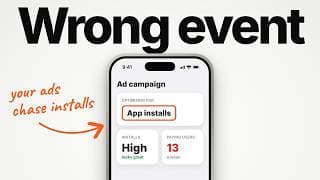
When a free trial ends, the store tries to charge the card. If that charge fails, Apple doesn't give up. It keeps retrying for up to 60 days.
If it never succeeds, Apple calls that involuntary churn: people who didn't mean to leave. And App Store Connect's analytics count it separately for free trials.
Look for two lines. Voluntary churns from free trials, and involuntary churns from free trials. Voluntary means they cancelled. Involuntary means the payment failed.
So how big can the second one get? In RevenueCat's report, failed payments were 14% of cancellations on the App Store. On Google Play, 31%. Almost a third.
That's across all subscriptions, not only trials. But it shows how much the word cancelled can hide.
Teal split its 760 lost trials. 140 were failed payments.
Using a subscription tool? Check the reason field. RevenueCat tags billing errors apart from unsubscribes. On Google Play, one cancel notification covers both kinds. So look up the cancel reason, not just the event.
Our take: never call a trial lost until you know which kind it was.
Fix the failed payments first. These people already said yes.
How do you win back a failed payment?Watch from 2:35
On the App Store, turn on Billing Grace Period. It keeps their paid access for a set number of days while Apple retries.
In App Store Connect: Apps, your app, Subscriptions, then Set Up Billing Grace Period. Pick 3, 16 or 28 days, for every plan. For week-long plans, it stops at 6.
Then comes the setting that matters for trials: which renewals it covers. Choose only paid to paid, and anyone coming out of a free trial gets no grace. Choose all renewals, and free trials turning paid are covered too.
Apple says a payment recovered inside grace means no gap in paid days or revenue. Without grace, they lose paid access while Apple keeps retrying.
Apple can also show a billing problem sheet inside your app, so people fix their card without leaving.
On Google Play, a grace period is on by default. Then comes account hold. During grace, keep their access. On hold, lock it.
Checkpoint: is your grace period on, and does it cover trials?
Our take: grace for trials gives a few free days to some who never pay. We'd still turn it on.
That handles the cards. Now the people who really did cancel.
When do real cancellations happen?Watch from 3:49
Teal's other 620 trials were cancelled on purpose.
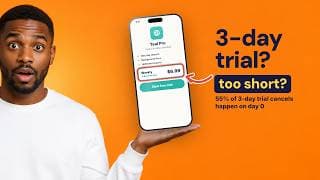
Start with when. For 7-day trials, about 40% of cancellations happen on the first day. Many people cancel before they've really tried the app. Trial length has its own video: Why Your 3-Day Free Trial Isn’t Working (And How To Fix It).
Here, check two more things. First, do people reach the thing they came for during the trial? Teal used to open with a tour. Now it opens on a photo, ready to edit.
Second, is the price after the trial clear before they start? Apple's docs put it plainly: subscriptions renew at the regular price when the free trial is over. So show that price, and the day it starts, right on the paywall.
Trial reminders? We found no public data on them, so test one yourself.
One last check: make sure your numbers are real.
Are your trials counted right?Watch from 4:44
Three things can make your trial count wrong.
One: test purchases. TestFlight and sandbox trials never charge anyone. If your analytics tool counts them, both your trials and your conversion are off.
Two: Family Sharing. A family member gets access through the person who paid. In Apple's server notifications, that can look like a new subscription. Check the ownership type.
Three: trials still in billing retry. RevenueCat parks them as inactive, neither converted nor lost. So a recent month can look worse than it ends up.
Checkpoint: filter out test accounts, family-shared access and trials still in retry.
Our take: count first, then fix.
Which fix is yours?Watch from 5:31
So here's the whole order. And one comparison tells you which fix is yours: involuntary churns from free trials, next to voluntary ones.
If failed payments are a big share, fix the payments. Grace period, all renewals, the billing sheet.
If real cancels are most of it, fix the trial. The first day, and a clear price.
Teal did both. It turned on grace for all renewals, and put a photo to edit on the first screen. Now a failed card doesn't lock anyone out. They keep editing while Apple retries.
Sources
- RevenueCat, State of Subscription Apps 2026 (115,000+ apps, 2025 data: median trial to paid by trial length; billing failures as a share of subscription cancellations; trial cancellations by day) (March 2026)
- Apple, App Store Connect Analytics Help, Subscriptions (Trial to Paid Conversion, Voluntary and Involuntary Churns from Free Trials)
- Apple, Reducing involuntary subscriber churn (billing retry up to 60 days)
- Apple, Enable Billing Grace Period for auto-renewable subscriptions
- Apple, Billing issue messages in StoreKit
- Apple, Implementing introductory offers in your app
- Apple, Testing in-app purchases with sandbox
- Apple, Supporting Family Sharing in your app
- Android Developers, Subscription lifecycle (grace period, account hold)
- Android Developers, Real-time developer notifications reference
- RevenueCat docs, Event types and fields (BILLING_ERROR, UNSUBSCRIBE)
- RevenueCat docs, Trial conversion chart
Caveat: RevenueCat measures trial to paid on trial starts; App Store Connect on completed trials only, so compare like with like. The 14% and 31% cover all subscription cancellations, not only trials. Longer trials convert better on average across apps, which is a pattern, not a promise for yours. Apple publishes no figure for how much revenue Billing Grace Period recovers. We found no public data on how much trial reminders help.