Why Your Mobile App Tracking Is Wrong (And How To Fix It)
The short answer
Mobile app tracking: the 7-event plan and which event your ads should learn from
Store, ad and payment dashboards never match because each counts something different, so give each number one job and make your payment records the source of truth for money. Track seven events, send trial starts and subscriptions to your ad platforms, and optimise your ads for the deepest event that still happens often enough for them to learn: for a small app, usually trial starts.
Key facts
- About 50Results a week an ad set usually needs to leave Meta's learning phase.Meta Business Help Center, About the learning phase
- 10 people a dayGoogle asks for an in-app action done by at least 10 different users a day in an App campaign.Google Ads Help, Best practices guide: Setting up your App campaigns
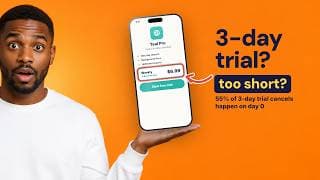
- 55%Of 3-day trial cancellations happen on day 0, so raw trial starts are a noisy signal.RevenueCat, State of Subscription Apps 2026, 19 March 2026
- 0 to 63The range of Apple's fine conversion value, sent only for the first window (days 0 to 2).Apple Developer, AdAttributionKit
Chapters
Transcript
Edited for readingCobalt is a fictional workout app built for this series; its screens are illustrative and its numbers are modelled from the sources below, not measured. Platform rules are as of 4 October 2026.
Mobile app tracking: why the numbers lieWatch from 0:00
In our model, the fictional app Cobalt gets about 13 paying users a week. Meta's ads usually need about 50 results a week, per ad set, to finish learning.
So Cobalt's ads can't learn from the one number that pays the bills. Right now, they aren't even told it. Its team can't see it either. Their dashboard shows downloads, and nothing else.
This is App Makeover. Today's fix comes first, because every other fix depends on it: tracking. By the end, you'll have the event plan we'd hand a real team, and you'll know which event your own ads should chase.
What does Cobalt's team actually see?Watch from 0:34
Quick recap. Cobalt is a home workout app we built for this series. Its screens and numbers are made up, modelled from real benchmarks. In our teardown, Why Your App Isn't Making Money (And How To Fix It), it sat in the bottom quarter of fitness apps on every step.
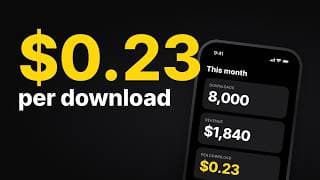
Let's open Cobalt's dashboard the way its team does. One number: 8,000 downloads last month, from the App Store and Google Play.
Now try some simple questions. How many people started a trial? How many paid? Which ad brought the people who paid? The dashboard can't say. The stores count downloads. Everything after the download is invisible.
Their only ad campaign, on Meta, has the same blind spot. Meta hears about installs, and that's all. So Meta does exactly what it's told. It finds people who install. Not people who start a trial, and not people who pay.
Picture what that does to a decision. Say Cobalt tries two ads. One brings cheap installs who never pay. The other brings fewer installs, and most of the payers. Judged on installs, the team keeps the wrong ad. Judged on payers, they'd keep the other one. Today they can't tell them apart.
Meta's own help pages explain the cost. Optimising for an in-app event shows your ads to people more likely to take that action. Cobalt never sends one.
This is common, even in apps that grow. One sleep app in an Adapty case study pulled its numbers together by hand. It took about five hours each time, so the team looked once a week. The case study says the team was making decisions on estimates.
Phiture's Mobile Growth Stack, a framework many growth teams use, puts analytics underneath everything. Getting users, keeping them and earning from them all sit on top.
Our take: an app that can't see its trials isn't running experiments. It's guessing, and calling it strategy.
Why don't the numbers match?Watch from 2:20
Say Cobalt's team tries to fix this by hand. They open three dashboards: the stores, Meta, and their payment records. The numbers don't agree. That isn't a bug. Each one counts something different.
Apple counts first-time downloads. A redownload is counted separately.
Meta counts an install when someone first opens the app, once per person, and only when it credits its own ads. Meta also says some of it may be modelled.
And on iPhone, many ad results come through Apple's privacy system. Those reports arrive days late, by design.
RevenueCat, which many subscription apps use to handle payments, says it plainly in its docs: don't compare all your trials directly with the ones Meta credits.
So the fix isn't forcing the numbers to match. It's giving each number one job, and one source you trust. The stores answer one question: how many people chose Cobalt? Meta answers another: which ads should we keep paying for?
And the payment records answer the one that matters most: how much money came in, and from whom? Those come from RevenueCat, and nowhere else.
A small gap between them is normal. What isn't normal is having no way to tell which number to trust.
Our take: three dashboards that disagree aren't lying. They're answering three different questions.
Which events should an app track?Watch from 3:36
Here's the event plan. Seven events, each with a name, a moment it fires, and a place it goes. Let's follow a new user and watch them fire.
They open the app for the first time: first open. They finish onboarding: onboarding complete. They start the free trial: trial started.
Three hours later, the trial is still active: qualified trial. Hold on to that one. It matters most.
The trial converts: subscribed. Later comes a renewal, or a cancellation.
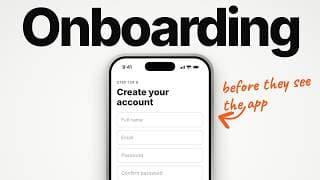
Onboarding complete is the one our next fix moves. Without it, nobody could tell whether a new onboarding worked.
That's the whole list. Seven events, not seventy, named the same way on iPhone and Android. Each event carries a few details: the plan, the price, and where the user came from. That's enough to split every number by source later.
Before anything ships, the team fires every event once on a test phone and checks it lands. Most tracking bugs are a name typed two different ways.
Next, where they go. Payments are the source of truth for money, so Cobalt adds RevenueCat for every trial and subscription. RevenueCat can send trial starts and subscriptions straight to Meta from its servers, even when the app is closed.
It also feeds an attribution tool. That tool joins each install to the ad that brought it, and each payment to that install.
One catch from RevenueCat's own docs: it doesn't update Apple's privacy conversion values. So Cobalt picks one tool to do that, and only one.
And if the Meta SDK also reports purchases, switch that off. A purchase sent twice gets counted twice.
Which event should the ads learn from?Watch from 5:14
Now the big decision. Which event should Cobalt's ads optimise for? The obvious answer is paying users. That's the money.
But look at the volume. Cobalt gets about 1,800 installs a week. About 50 trials. About 13 paying users.
Meta says an ad set usually leaves its learning phase after about 50 results in a week. Below that, its status reads learning limited.
Pause and guess. Even if every paying user came from one ad set, how close would Cobalt get? About a quarter of the way: 13 out of 50. Meta would keep testing and never settle. The ad set would stay stuck in learning limited.
So optimising for purchases would leave Cobalt's ads learning forever. Meta's own advice is to pick an event that happens more often.
Trials happen about four times as often. That's about 50 a week, right on the line, but only if every trial came from ads. Most won't.
Raw trials are noisy, too. In RevenueCat's 2026 report, 55% of 3-day trial cancellations happen on day 0. We saw that number before, in Why Your 3-Day Free Trial Isn't Working (And How To Fix It). A trial cancelled within minutes still looks like a win to the ad system.
That's where the qualified trial comes in. Airbridge, an attribution company, suggests firing it 2 to 4 hours after the trial starts, if it's still active. Their simplest version waits three hours.
It's a cleaner signal. But it fires less often than raw trials, so at Cobalt's volume it can't clear the bar yet.
Google is stricter still. It asks for an in-app action done by at least 10 different people a day. Cobalt gets about 7 trials a day, from every source. It also wants a daily budget of at least 10 times your target cost per action. That's a big ask for a small app.
So here's the decision. Send every event now, so the platforms build history. Keep Meta in one ad set, optimising for trial starts. It may still read learning limited, but it's the closest event to the bar that says something about money.
Move to the qualified trial once ad-driven trials pass 50 a week. Airbridge puts the rule simply: use the deepest event that still clears the bar.
Does chasing a deeper event pay? In a 2016 Meta announcement, the karaoke app Smule reported a 32% lower cost per purchase. That's one app, years ago. Treat it as a sign, not a promise.
Our take: the right event isn't the most valuable one. It's the most valuable one your volume can feed.
What does Apple's privacy layer change?Watch from 7:43
One more layer. On iPhone, many ad results come through Apple's AdAttributionKit, which works alongside the older SKAdNetwork. It never tells Cobalt who a user is. It sends back a small number, called a conversion value.
In the first window, days 0 to 2, that number can be anything from 0 to 63. After that, it's only low, medium or high.
It also arrives late. The first report comes a day or two after its window closes.
Apple also checks crowd size. With small numbers, a report may only say low, medium or high, or carry no value at all.
Apple also lets apps set how long a click or a view can count: up to 30 days after a click, and up to 7 after a view.
So Cobalt builds its value plan around those first two days. A small step for onboarding and more for a trial. More again for a qualified trial, and the top for a subscription. In the later windows, low means the trial is still running, medium a paying user, and high a renewal.
Meta's setup guide adds one rule: never lower a conversion value once it's set.
What changed on the scoreboard?Watch from 8:50
Back to the dashboard. Here's the after. Monthly downloads, trials and paying users, and revenue per install, each with one source. And every ad platform now hears about trials and payments.
The team's regular meeting changes too. Three questions, each answered from one place. How many trials did we start? How many paid? Which campaign brought the payers? That takes minutes, not an afternoon. And the team can finally decide on numbers instead of estimates.
Now the scoreboard: store page, download to trial, trial to paid, revenue per install. Not one number moved.
That's on purpose. Tracking doesn't make Cobalt better. It makes every later fix measurable. When we fix onboarding, Cobalt will see whether trials actually rise. It's also why paid growth comes later in the series. The ads need this plumbing first.
What this can't tell you. The thresholds are Meta's and Google's current guidance, and they change. Cobalt's volumes are modelled from category data. A real team would set its qualified trial from its own data.
With tracking in place, Cobalt can finally see where people leave. The first leak is on the very first screen: Why Your App Onboarding Is Failing (And How To Fix It).
Sources
- Meta Business Help Center, About the learning phase
- Meta Business Help Center, About learning limited
- Meta Business Help Center, About app event optimization
- Meta Business Help Center, Mobile app installs metric
- Meta Business Help Center, Prepare your app integration for Apple's SKAdNetwork
- Google Ads Help, Best practices guide: Setting up your App campaigns
- Apple Developer, AdAttributionKit
- Apple, App Store Connect Analytics metric definitions
- RevenueCat docs, Meta Ads integration
- RevenueCat, State of Subscription Apps 2026 (19 March 2026)
- Airbridge, Qualified trials for fitness apps (16 March 2026)
- Adapty, Renight case study (19 June 2026)
- Phiture, What is the Mobile Growth Stack
- Meta for Business, Grow your Business Beyond the App Install (Smule) (18 July 2016)
Caveat: Cobalt's weekly numbers are Appelune calculations from its modelled monthly baseline (8,000 downloads, 216 trials and 56 payers a month, RevenueCat 2026 bottom quarter): 1,846 installs, 50 trials and 13 payers a week, 7 trials a day, all sources. Smule's result is one app's, in 2016, and is not modelled for Cobalt. The two ads, the three dashboards and the test-phone check are illustrative.