Why Your App Onboarding Is Failing (And How To Fix It)
The short answer
App onboarding: what to cut, ask and show before the free trial
Onboarding happens on download day, when most fitness trials start, so give before you ask. Promise what people get on the first screen, ask only questions that change the plan, show the plan straight away, ask for notifications when the reason is on screen, and move the account to after the first workout. In four published tests, changes like these raised trials by 6% to 25%.
Key facts
- 82%Of Health and Fitness app trials start on download day.RevenueCat, State of Subscription Apps 2026
- 55%Of 3-day trial cancellations happen on the day the trial starts.RevenueCat, State of Subscription Apps 2026
- 6% to 25%How much trials rose in four published tests of onboarding changes. None was a fitness app.Adapty, How to fix your app onboarding flow (Real A/B test data inside), 25 November 2025
- 20.5 screensMedian onboarding length in one small study of 26 fitness app flows.Lazyweb Research, How Many Onboarding Screens Do Health & Fitness Apps Have?, 7 July 2026
Chapters
- 0:00Where do fitness app trials start?
- 0:30Where does Cobalt's onboarding lose people?
- 2:24Why is download day so important?
- 4:01What should an app's first screen do?
- 4:53Which questions should onboarding ask?
- 6:18When should an app ask for notifications?
- 7:31What does the new onboarding do to trials?
- 8:34What can't this model tell you?
Transcript
Edited for readingCobalt is a fictional workout app built for this series, and Alex is a made-up test user; the screens are illustrative and the scoreboard is modelled from the sources below, not measured.
Where do fitness app trials start?Watch from 0:00
Onboarding happens on download day, when 82% of fitness trials start. So onboarding gets one day to earn most of those trials.
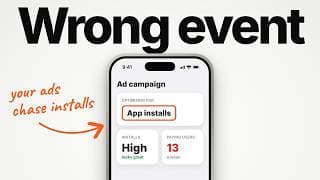
This is the onboarding of Cobalt, the made-up workout app we're fixing one part at a time. It opens with a sign-up wall. Then fourteen screens, mostly questions. And at the end, no plan.
Today we rebuild it, screen by screen, and work out what it's worth in trials. By the end, you'll see the onboarding map: every old screen, and what happened to it.
Where does Cobalt's onboarding lose people?Watch from 0:30
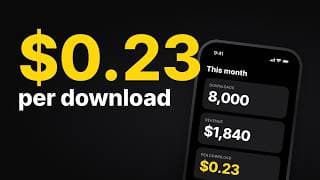
First, where Cobalt stands. When we scored it against fitness apps, it sat in the bottom quarter. Its weakest step was download to trial. A typical fitness app gets about seven trials from every hundred downloads. Cobalt gets under three.
Since its last fix, Cobalt tracks who finishes onboarding and who starts a trial.
Let's install it and walk through as a new user. The first screen isn't the app. It's a sign-up form. Email, password, create account.
Apple's own design guidelines say to delay sign-in as long as possible. People often leave when they're forced to sign in first. Apple's review rules go further: if an app doesn't have significant account-based features, let people use it without a login. A workout plan doesn't need an account on day one.
Alex, our test user, signs up anyway. Next comes a name. Then a request to send notifications. The only reason given is reminders, tips and news. Alex hasn't seen a single workout, so Alex taps the not now button.
This sheet is Cobalt's own, and it guards something scarce. On iPhone, the system asks once. If someone says no, the app usually can't ask again.
Then eleven more questions. Age. How you heard about Cobalt. Gender and height. Where you train, how often, your level, equipment, workout length, time of day. Then access to Health data.
And here's the real problem. None of those answers changes anything Alex sees next. The last screen says you're all set. No plan. Just a button to the paywall.
By the time Alex sees a price, Cobalt has asked for an account, a name, a permission and eleven answers. It has given back a checkmark.
Length isn't the mistake. One small study of fitness apps found about twenty onboarding screens at the median.
Our take: every question should change the plan, or go.
Why is download day so important?Watch from 2:24
That 82% is one side of the trial story. Here's the other. Cobalt's weekly plan comes with a three-day trial.
Pause and guess. Of the people who cancel a three-day trial, how many do it on day zero? More than half. 55% of those cancellations happen on the day the trial starts.
So most fitness trials start on download day. And for three-day trials, more than half of cancellations come on the trial's first day. For most fitness trials, that's the same day. Onboarding is the first part of it. It's where Cobalt gives people a reason to try, or doesn't.
So what do apps that fixed this change? Start with the sign-up. When Duolingo moved its sign-up screen back a few steps, daily active users rose about 20%. That's one app, years ago, when it was free, so it says nothing about trials. But it points the same way as Apple.
Next, the notification ask. Apple's developer docs say to ask in a context that shows why. In Apple's example, a to-do app might ask after someone schedules their first task.
Calm tried something close. It asked some new users to set a reminder right after their first session. 40% of those who saw the prompt set one. Before that, fewer than one in a hundred users were finding reminders on their own.
Then the flow as a whole. We found four published tests of onboarding changes like these. Trials rose between 6% and 25%. Each is one app, and none is fitness. Where Cobalt lands in that range is the last thing we'll work out.
What should an app's first screen do?Watch from 4:01
Here's the rebuild. Same app, same colours, same prices. One decision at a time.
Decision one. The first screen stops asking and starts promising. It reads: your strength plan in five questions, then try it free. Alex knows how much is coming, and that a trial waits at the end.
No surprise price after a quiz. The price was always coming, and now Alex knows it. A small log in link stays on the first screen, for anyone coming back.
The account moves to the end, after the first workout, as a way to save progress. Asked there, it lands differently. Now there's something to lose: a finished workout and a twelve-week plan.
One rule still applies. If Cobalt offers accounts, Apple requires a way to delete one inside the app.
Our take: give people something before you ask for anything.
Which questions should onboarding ask?Watch from 4:53
Decision two. Five questions, and each one changes the plan. Watch the top of the screen: every answer lands on the plan as you go.
What do you want to build first? Strength. How many push-ups can you do right now? Six to fifteen. How many days a week? Three. How long? Twenty minutes. Any equipment? None.
Each answer earns its place. The goal picks the programme. The push-up answer sets the starting level, so day one isn't too hard. Days and length build the schedule. Equipment picks the exercises. And every question has a skip link. Skip, and Alex still gets a starter plan.
The other questions move or go. How Alex heard about Cobalt helps marketing, not Alex's plan. It moves to after the first workout, as one optional tap. Gender and height don't change a bodyweight plan. Health data waits until Alex opens progress.
Decision three. The plan shows up straight away, with no fake loading bar. The evidence on those is mixed. One education app removed its loading screen, and trial conversions rose 22%. And one of our four winning tests had a customising screen, which is the same idea. With evidence both ways, Cobalt keeps it simple: the plan, straight away.
Twelve weeks. Three sessions a week, twenty minutes each, no equipment. And week one, day by day.
When should an app ask for notifications?Watch from 6:18
Now the decision that's easy to get wrong. When do you ask for notifications?
Decision four. Right here, after the plan, with the plan's own schedule on screen. A nudge on your three training days, at a time you pick. Now the reason is right there.
Like before, it's Cobalt's own screen, so the system prompt waits for a yes. The difference is the reason on it. And if Alex taps not now, Cobalt offers again after the first workout.
On Android 13 and later, notifications start switched off. After two refusals, the system stops showing its prompt. So the rule is the same: ask when the reason is on screen.
The paywall comes next, and it stays exactly as it was. Same screen, same prices.
Decision five. When the trial starts, Alex lands on the plan's first workout, not a home screen full of choices. More than half of three-day trial cancellations happen on day zero. A first workout that day gives people a reason to keep the trial.
Here's the onboarding map. Every old screen, and what happened to it. Fifteen screens before the paywall became eight. That wasn't the goal. It's what's left when every screen has a job.
What does the new onboarding do to trials?Watch from 7:31
Here's the whole new onboarding, the way Alex meets it now, beside the old one.
Now the scoreboard. Back to those four tests, from 6% to 25%. Each is a single app, and none is fitness. So we model Cobalt at the bottom: 6% more trials. Download to trial goes from 2.7% to 2.9%.
Cobalt gets about 216 trials a month. Pause and guess. How many more does 6% buy? Now it's about 230. Fourteen more. About four more people paying each month.
Revenue rises too, by about $75 for a month of downloads.
At the top of the range, Cobalt would get 270 trials. From the same downloads, a typical fitness app gets 552.
What can't this model tell you?Watch from 8:34
What this can't tell you. The tests come from other kinds of apps, and vendors publish their wins. And Cobalt made five changes at once.
We also didn't count fewer day-zero cancellations, because we found no test that measured it. A real team would ship this as a split test, and read it on onboarding complete and trial started.
So onboarding, counted honestly, closes a small part of the gap.
Cobalt's onboarding now gives before it asks.
Sources
- RevenueCat, State of Subscription Apps 2026
- Apple Human Interface Guidelines, Managing accounts
- Apple App Review Guidelines, 5.1.1(v) Account Sign-In
- Apple Developer Documentation, Asking permission to use notifications
- Android Developers, Notification runtime permission
- Android Developers, Request runtime permissions
- Lazyweb Research, How Many Onboarding Screens Do Health & Fitness Apps Have? (7 July 2026)
- First Round Review, The Tenets of A/B Testing from Duolingo's Master Growth Hacker (17 July 2017)
- Amplitude, How Calm Increased Retention 3X With Amplitude (14 July 2016)
- Adapty, How to fix your app onboarding flow (Real A/B test data inside) (25 November 2025)
- RevenueCat blog, How Applica redesigned Five Minute Journal's onboarding (23 October 2024)
Caveat: Cobalt's numbers are Appelune calculations from its modelled baseline (8,000 downloads a month, 2.7% download to trial, 216 trials, 26.1% trial to paid; RevenueCat 2026 bottom quarter). The lift is +6.4%, the lowest of the four published tests, applied to trials only; revenue grows only for trial payers (about 64% of Cobalt's payers). None of the four tests is a fitness app, vendors publish their wins, and the five changes were not tested one at a time. Fewer day-0 cancellations were not counted. Duolingo's and Calm's results are one app's each, years ago, and are not modelled for Cobalt.