How Free Apps Make Money (And Why They Charge Weekly)
The short answer
How do free apps make money? Ads, purchases and weekly plans
Free apps make money three ways: ads, things you buy inside the app, and subscriptions. Ads work best for apps with a huge daily crowd. Only about 2 in 100 downloads of free-to-start subscription apps pay within five weeks, and in Adapty's data weekly plans now bring in 55.5% of the money. Multiply any weekly price by 52 to see what it costs over a year.
Key facts
- 55.5%Share of the money weekly plans brought in across Adapty's subscription apps in 2025, up from 43.3% in 2023.Adapty, State of In-App Subscriptions 2026, 5 March 2026
- 2 in 100Downloads of free-to-start subscription apps that had paid within five weeks (median, day 35).RevenueCat, State of Subscription Apps 2026
- About 1 in 100Weekly subscriptions still paying a year after they started, against about 27 in 100 for yearly plans.RevenueCat, State of Subscription Apps 2026
- $151B vs $149BAd money inside apps on Apple's App Store in 2025, against what people spent in those apps (a study supported by Apple).Apple Newsroom, App Store ecosystem 2025 (Analysis Group study supported by Apple), 4 June 2026
- $94.50 of every $100Subscription money taken by the top tenth of apps in Adapty's 2025 data.Adapty, State of In-App Subscriptions 2026, 5 March 2026
Chapters
Transcript
Edited for readingTeal and Tile Drop are fictional apps made for this video; their screens and prices are illustrative. Every other figure comes from a real source, listed under Sources.
How do free apps make money?Watch from 0:00
How do free apps make money? Three ways: ads, things you buy inside the app, and subscriptions.
And in subscription apps, the biggest earner is now a plan you pay for every week. In Adapty's data, weekly plans brought in 55.5% of the money last year.
Ever wondered why apps keep asking for a few dollars a week? Here's how all three ways work, and who really pays.
Do ads really pay for free apps?Watch from 0:24
Start with ads, the oldest way. The app shows you an ad. An ad network pays the app when people see it or tap it.
That money is bigger than most people think. A study paid for by Apple counted ad money inside apps on Apple's App Store: $151 billion in 2025. That's slightly more than the $149 billion people spent in those apps.
Our take: ads work best for apps with a huge crowd that opens them every day. So if a free app has no paywall and no shop, you're paying with your attention.
Most apps want more than your attention, though.
What do people buy inside free apps?Watch from 0:59
The second way is buying things inside the app. Coins, extra lives, a filter pack, or a one-off unlock.
People spent $167 billion inside apps and games in 2025. That includes subscriptions. And for the first time, apps took more of it than games.
Here's what surprises people. Almost nobody pays. RevenueCat looked at subscription apps that are free to start. About 2 in 100 downloads had paid within five weeks. The other 98 hadn't paid yet.
Our take: free apps run on a small group of payers. The rest of the app is built to find them.
And the way apps charge those payers has changed fast.
Why do so many apps charge by the week?Watch from 1:40
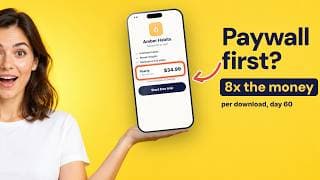
The third way is subscriptions. Here's Teal, a made-up photo editor we use as an example. Its paywall offers a week, a month, or a year. Across Adapty's apps, which plan do you think brings in the most money?
Weekly. 55.5% of all the money, up from 43% just two years earlier. Yearly plans brought in just over a fifth of the money. Monthly, just over a tenth.
Now look at the price. The typical weekly price in Adapty's data was about $7.50. That sounds small. But keep it for a year and it's about $389. The typical yearly plan, across all those apps, was about $38.
Our take: a weekly price is easy to say yes to. You see the small number, not the yearly one.
So why doesn't every app charge weekly? A different dataset shows why.
Do weekly subscribers stay?Watch from 2:41
RevenueCat counted how many subscriptions were still paying a year after they started. Yearly plans: about 27 in 100. Monthly plans: about 8. Weekly plans: about 1. So weekly money tends to come in short runs, not long relationships.
Our take: weekly plans fit apps you need for a quick job, like fixing one photo. If an app needs you every day for years, a yearly plan usually makes more sense.
Which leaves one question. Who ends up keeping the money?
Who keeps the money?Watch from 3:13
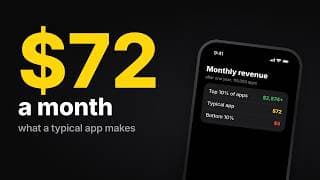
Mostly, the top tenth of apps. In Adapty's data, they took most of the subscription money: $94.50 of every $100. The other 90% of apps shared the last $5.50.
We broke those numbers down in How Much Money Do Apps Actually Make?
How can you tell before you download?Watch from 3:29
So how can you tell how a free app makes money, before you download it?
On Google Play, an app with ads has to show a Contains ads label on its store page. On the App Store, Apple says to look for the words In-App Purchases near the Get button.
Then open the app. A paywall with a free trial in the first few screens usually means subscriptions.
Our rule: check every plan on that paywall, not just the one that's ticked. Teal's weekly plan is $6.99. Over a year, that's about $363. Its yearly plan is $39.99.
The answer, and the ruleWatch from 4:06
So, how do free apps make money? Ads, if they have a huge crowd. Paid extras, from the few who pay. And more and more, a weekly plan that a few people keep for a short while.
Here's a rule you can use today. When an app shows a weekly price, multiply it by 52. That's what it costs if you keep it for a year.
Sources
- Apple Newsroom, App Store ecosystem 2025 (Analysis Group study supported by Apple): in-app advertising $151 billion, digital goods and services $149 billion (4 June 2026)
- Sensor Tower, $167 billion in-app purchase spending in 2025 (App Store and Google Play, gross, includes subscriptions) (21 January 2026)
- RevenueCat, State of Subscription Apps 2026
- Adapty, State of In-App Subscriptions 2026 (16,000+ apps, mostly App Store) (5 March 2026)
- Google Play Console Help, "Contains ads" label
- App Store, About in-app purchases
Caveat: Different datasets are never combined in one chart. Our maths: 98 of 100 (100 minus 2.1), $389 ($7.48 x 52), $363 ($6.99 x 52), $5.50 (100 minus 94.50).